SAGA for Deviation Investigations
Give the investigation a clear path to the report.
An event needs to be understood. The investigation needs to explain what happened, what the evidence supports, and what it means for the product.
SAGA helps your team describe the event, find relevant earlier cases, and work through the investigation within your procedure. Prepare the deviation investigation report and disposition rationale as the work develops, with your specialists assessing the findings and Quality deciding the disposition.

01
Establish what happened before deciding why.
A useful investigation starts with a factual account: what was observed, when and where it occurred, what was affected, and what immediate correction was made.
SAGA guides that preparation and a provisional classification for Quality to assess. The investigation follows a risk-proportionate approach within your procedure. Smaller cases can use fewer sections of the same adaptable template, so a later reclassification can be handled within the case structure.
Your investigators evaluate causes and product impact. A possible explanation remains a hypothesis until the evidence supports it.
02
Find how similar events were handled.
Earlier cases can help the investigator ask better questions. Was the same equipment involved? Did the event occur at the same process step? Was the earlier action effective?
SAGA can search imported deviation history by equipment, process step, product or batch, and cause category. Your specialist decides whether a case is relevant and what it contributes to the current investigation.
This uses the history supplied to SAGA. It does not provide automatic trending across your entire QMS.
03
Bring the case material into the investigation.
Relevant input includes the event description, observations, batch or lot information, applicable procedures, previous deviations, and investigation results.
Your team supplies files, such as Word, Excel, PDF, or PowerPoint documents. SAGA imports the material; this workflow can work from exported files without a connection to your source systems. Imported history becomes available for subsequent case searches.
The completeness and relevance of that material remain part of the investigator’s assessment.
04
Prepare the report and the decision material.
The main deliverable is a deviation report covering the event, relevant process or equipment background, classification, investigation, root cause, product impact, corrections, and summary.
SAGA also helps prepare the disposition rationale, with the reasoning and evidence your authorized people need to consider. Where escalation is appropriate, a CAPA handover carries the relevant case context forward.
The user initiates the work and confirms each draft before it is saved. Specialists review the content; completed review precedes export in Word or the agreed customer format. Formal approval and signature take place in your controlled system.
05
An example: examine recurrence without assuming the cause.
Illustrative workflow based on the documented module description. The case is fictional and contains no customer findings or measured result.
A QA specialist is investigating an interruption on a tablet press. The team supplies the event description, batch records, the relevant SOP, and imported deviation history. Two earlier cases on the same equipment are found in that supplied history.
The investigator compares the circumstances and examines whether other batches or time periods could be affected. Similar equipment does not establish a common cause. Maintenance observations and other investigation results need to be assessed before a conclusion is justified.
SAGA helps develop the report and disposition rationale from that work. Quality evaluates the product impact and decides the disposition. A CAPA handover can be prepared if the assessment calls for further action.
06
Share the finding with the specialist who needs to assess it.
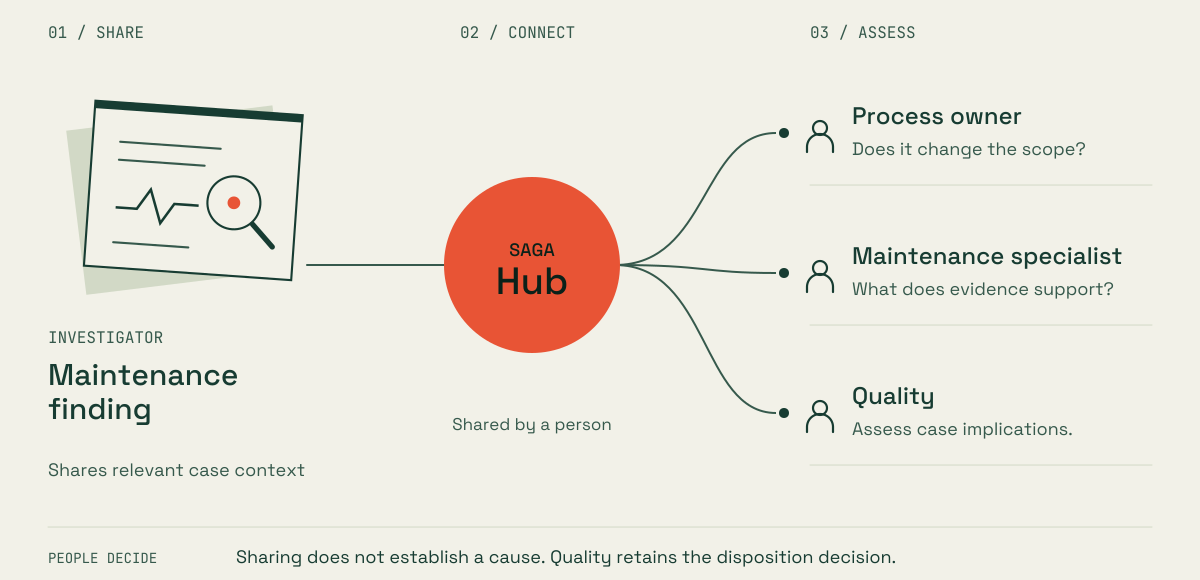
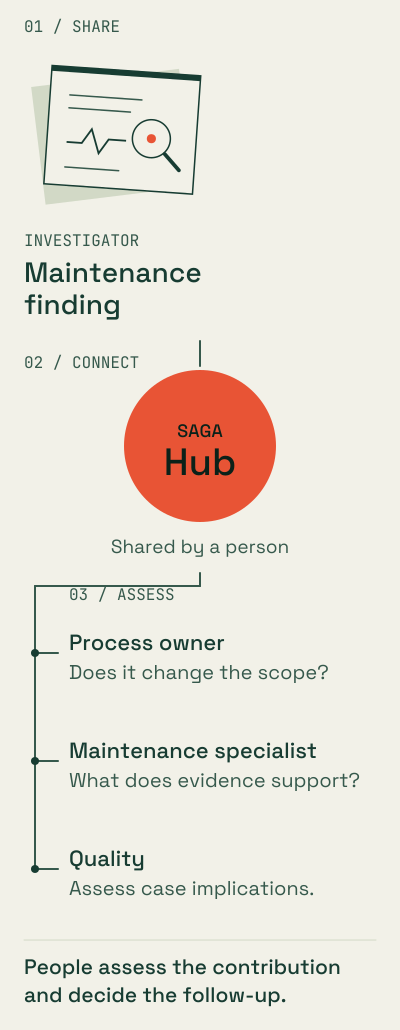
An investigation may need input from maintenance, operations, validation, or another specialist. Where Hub is included in the agreed setup, SAGA Hub can carry relevant findings and handovers between project participants. The recipient works with their agent to consider the update in their own context.
In the illustrative tablet-press case, the investigator might share a maintenance finding with the process owner to assess whether it changes the investigation's scope. That assessment becomes part of the team's work on the case; sharing a message does not establish a cause or a disposition.
Your investigator evaluates the contributions, and Quality retains the decision. Hub supports communication; formal approval remains in your QMS.
07
Quality retains the decision.
SAGA supports investigation and report preparation. Your team determines whether the evidence supports the conclusion, and your authorized Quality function makes the disposition decision. SAGA does not release batches, approve records, or sign documents. Your QMS remains authoritative.
LET’S TALK
Discuss the case structure your team works with.
Tell us how your team investigates deviations, what history is available, and what your report needs to contain. We can discuss a SAGA workflow around that task.