SAGA for Corrective and Preventive Action
Define what success means before the CAPA action starts.
An action plan needs a clear connection to the problem and a way to assess whether the action worked.
SAGA helps your team investigate the problem, prepare actions with owners and deadlines, and define measurable effectiveness criteria before implementation. The work develops into one CAPA record, with review material prepared for the stages defined by your procedure.

01
Keep the problem, the action, and the evidence together.
A CAPA can start from a deviation, complaint, audit finding, or trend. Your team needs to establish its scope, investigate the cause, agree appropriate action, and assess the outcome.
SAGA supports that work in a dedicated workspace for each CAPA. The main record develops through the case, bringing the investigation, plan, specialist contributions, and assessment material together.
For CAPA owners and Quality teams, the purpose is practical: make the reasoning and evidence available when a decision is needed.
02
Start from the source case and your procedure.
Bring the initiating case, problem data, relevant procedures, earlier CAPAs, and available investigation or monitoring results. Your team supplies files for import; this workflow does not require a source-system connection.
Earlier imported CAPAs help your team examine what was done before and whether it worked. Specialists contribute their conclusions and evidence to the current case. Your people assess how those contributions affect the investigation and action plan.
03
Prepare the record through the decision stages.
01
Initiation.
Describe the problem, source, scope, containment, and preliminary risk. Prepare the material needed to establish the case under your procedure.
02
Investigation and plan.
Work through the systemic cause and its supporting evidence. Prepare actions with an owner and deadline for each. Define effectiveness criteria and the assessment method before implementation, then submit the plan for the required customer approval.
03
Implementation and closure material.
Your people carry out the approved actions and supply the evidence. SAGA helps document the work and prepare the implementation-verification and closure material for your authorized reviewers.
04
Effectiveness assessment.
Assess the actual results against the criteria agreed in advance and record the conclusion. Your procedure determines the relationship between effectiveness assessment, closure, and any reopening.
SAGA supports packages for initiation, plan approval, closure, and effectiveness assessment. The timing and authorization of these stages follow your organization's procedure.
04
An example: separate “done” from “effective.”
Fictional educational example within the documented CAPA workflow. Proposed criteria illustrate planning; they are not prescribed thresholds or evidence of a successful CAPA.
A quality engineer is coordinating a CAPA after repeated complaints about the same label error. The investigation supports a problem in the label-change verification process. The proposed action is to revise that process and train the relevant operators.
The team defines two different questions before implementing the plan:
- Implementation: Was the revised process approved and introduced, and did the relevant operators complete the required training?
- Effectiveness: Across the next three batches using the revised process, does the documented label verification meet the agreed acceptance criteria, with no recurrence of the defined error?
Quality must assess whether three batches provide a meaningful basis for this case and whether the monitoring period, sample, and criteria are sufficient. The action owners then perform the work and collect the actual evidence.
SAGA helps prepare the plan and assessment material. The team reviews the results and decides whether further action or reopening is needed. A completed training record alone does not answer the effectiveness question.
05
Bring specialist contributions back into the CAPA.
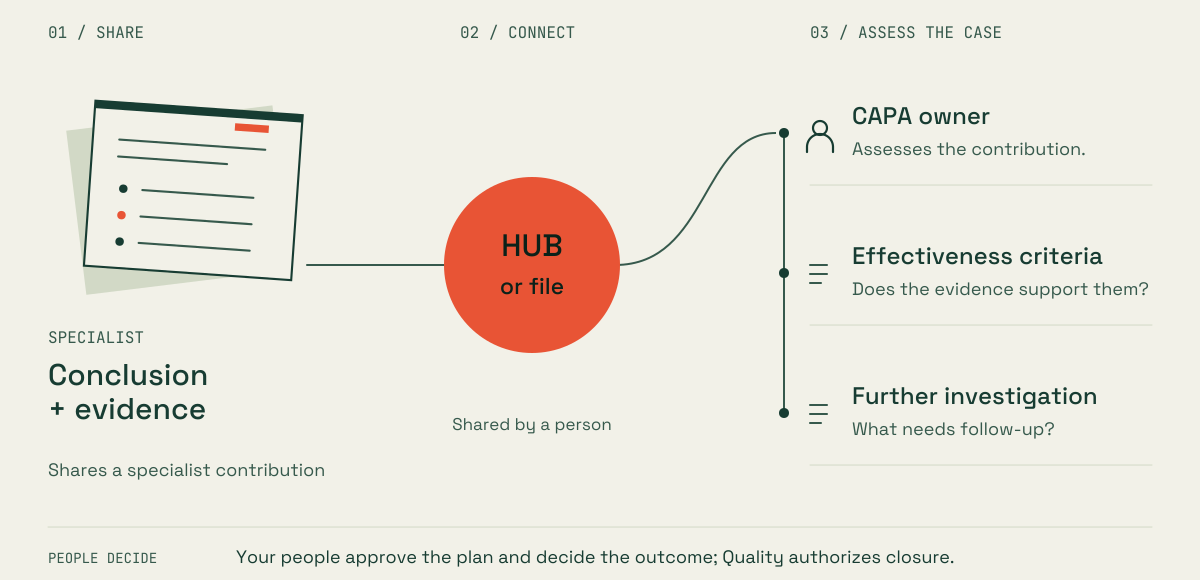
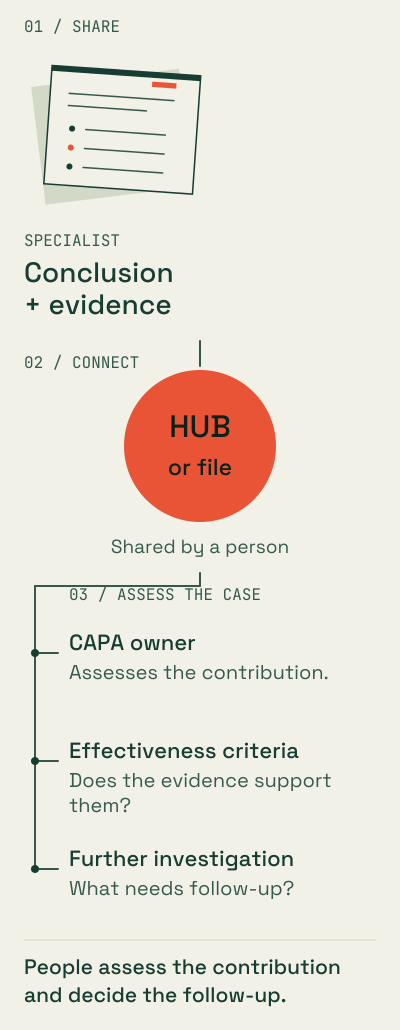
A CAPA may involve people working on procedures, equipment, training, or validation. With SAGA Hub included in the agreed setup, specialist contributions can be shared between colleagues' working areas. Each contribution should bring the conclusion and supporting evidence into the case, so the CAPA owner can assess what it means for the plan or effectiveness assessment. When Hub is not used, contributions can be passed on as files.
In the illustrative label-error case, a specialist might share findings from checking the revised verification process. The CAPA owner assesses whether those findings support the agreed effectiveness criteria or call for further investigation.
Your people initiate the exchange and decide how to follow up. Hub does not approve the plan or authorize closure.
06
Your people perform the actions and authorize the outcome.
The user starts the task and confirms each draft before it is saved. Specialists assess the content, and completed review precedes export to the customer's controlled system.
Your designated people approve the plan; Quality authorizes closure under your procedure. SAGA does not perform the corrective action, approve or close the CAPA, sign records, or provide trending across the whole QMS.
LET’S TALK
Bring a CAPA workflow to the conversation.
Tell us where your case begins, what your approval stages require, and how you assess effectiveness. We can discuss how SAGA could support that work and the record it needs to produce.