SAGA for Equipment Qualification
Make the equipment requirement clear before the test.
The supplier describes what the equipment can do. Your team needs to establish what it must do in your process.
SAGA helps prepare equipment requirements through a defined workflow, using the intended use, relevant project material, your procedures, and agreed templates. Your specialists assess the draft and decide whether it describes the need precisely enough to take forward.

01
Connect the equipment to the work it will perform.
A specification becomes useful when it reflects the actual process: what is handled, under which conditions, by whom, and with which quality considerations.
For equipment owners, engineering, and qualification teams, that means examining the intended use alongside supplier information and site requirements. A feature list alone does not explain whether the proposed equipment fits the task.
SAGA’s Equipment Validation module supports requirement preparation within an agreed workflow. We define the relevant tasks and deliverables with your team, so the scope is clear from the start.
02
Bring the intended use and the relevant project material.
Start with the equipment’s purpose, the process and operating conditions, relevant procedures, available supplier specifications or drawings, known constraints, and the template your team uses for requirements.
Your specialists use that material to distinguish a defined need from an assumption. If a temperature range, load condition, cleaning requirement, or operator action has not been decided, the responsible person needs to resolve it before the requirement can be approved.
03
Prepare a requirement your specialists can examine.
01
Describe the task.
Define what the equipment is expected to do and the conditions that matter to its use.
02
Work through the requirement.
Use SAGA’s supported workflow and template to prepare the wording. Bring your procedure and relevant project context into the task.
03
Review its meaning.
Your specialist checks whether the requirement is accurate, justified, and sufficiently specific to assess. Confirm the requirement before it is saved; formal review and approval follow your procedure.
04
Carry the decision forward.
The reviewed requirement gives your team a reference for subsequent design and qualification work. We agree any additional SAGA deliverables separately for the equipment workflow.
04
An example: what does “temperature controlled” mean?
Illustrative requirement-preparation example. The equipment, conditions, and values are fictional and require a project-specific rationale.
A team is specifying a cabinet to hold sealed process samples. The initial note says: “The cabinet must maintain the right temperature.”
The specialist first defines the intended operating range, usable storage space, loading conditions, and the period over which performance matters. A candidate requirement can then state:
The cabinet shall maintain all designated storage locations between 20.0°C and 25.0°C during an eight-hour closed-door holding period with the maximum approved load, after stabilization.
That sentence gives the reviewer something specific to question. Are those limits justified? What is the maximum approved load? How is stabilization defined? Which locations need to be represented in the qualification study?
The specialist resolves those questions before approval. The requirement is a proposed target; actual equipment performance must be demonstrated through the qualification work.
05
Bring engineering and qualification into the same conversation.
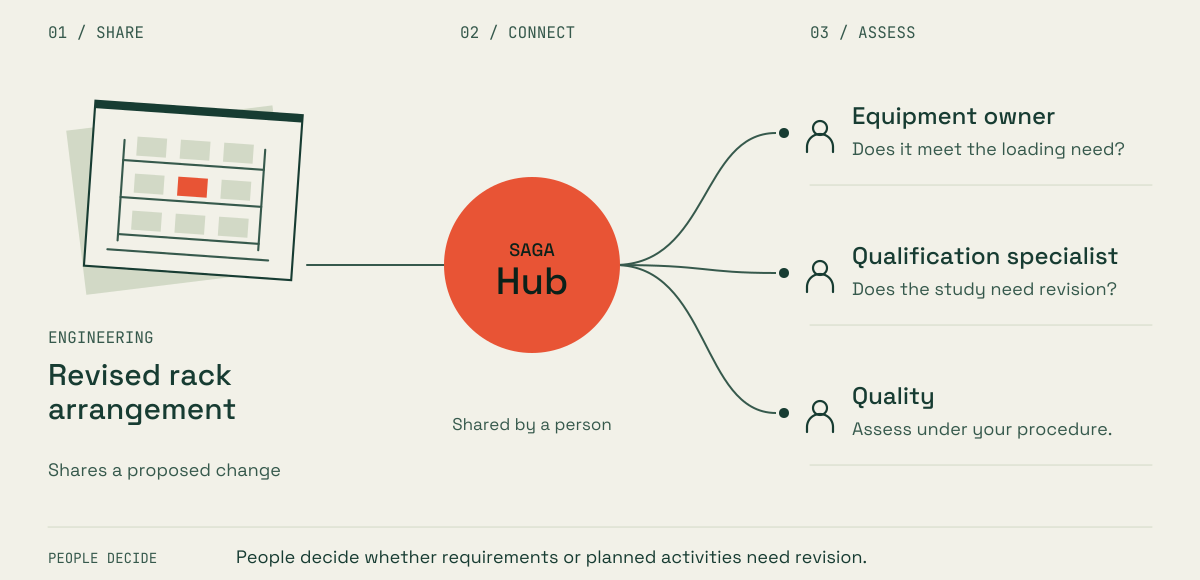
An equipment decision can affect several disciplines. Where SAGA Hub is included in your setup, project participants can share a finding, decision, or handover and examine its implications with their own agents.
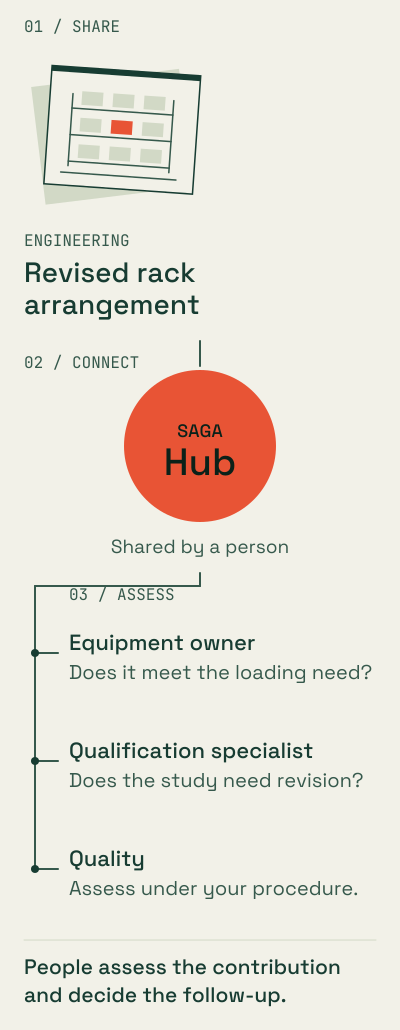
In the illustrative cabinet project, engineering might propose a revised rack arrangement. The equipment owner can assess whether it still meets the loading need, while the qualification specialist considers its implications for the proposed temperature study. Relevant Quality participants can assess the change under your procedure.
Hub carries the update between participants. Your specialists decide whether requirements or planned activities need revision and carry out the follow-up.
06
Keep preparation and executed evidence connected.
Equipment qualification can involve design qualification, installation qualification, operational qualification, and performance qualification. The applicable stages and their scope depend on the project. These stages provide a wider context for the requirements work described here. EU GMP Annex 15, section 3.
Your organization determines the qualification strategy, performs the activities, reviews the actual results, and authorizes the next steps. SAGA’s documented requirement-preparation support does not establish equipment performance or promise a complete IQ/OQ/PQ package. Formal approvals, signatures, and controlled records remain in your systems.
LET’S TALK
Start with the requirement your team needs to settle.
Bring an equipment task, the relevant project material, and the deliverable you are preparing. We can examine where structured preparation would help and define a realistic SAGA scope with you.