SAGA for Computer System Validation
Computer system validation starts with a clear purpose.
What does the system need to do? Which risks matter? What evidence will your team need?
SAGA helps CSV teams work through those questions and prepare the agreed GxP deliverables. Requirements, risk, configuration, and test preparation follow defined workflows shaped by your procedures and project context. Your specialists direct the work and assess the content.

01
Give related deliverables a shared starting point.
A user requirement can influence the risk assessment, the configuration specification, and the testing that follows. The people preparing those deliverables need a clear understanding of the same intended use, scope, and decisions.
SAGA provides defined roles and tasks for that preparation. Your specialist selects the relevant task, works through the questions, and reviews the contribution before taking it forward.
The documented CSV example supports preparation of user requirements, a system risk assessment, a configuration specification, a validation plan, and test scripts. We agree the roles, templates, and supported tasks for your project before the work begins.
02
Start with the material that defines your project.
Bring the system’s intended use and project scope, business discussions or discovery notes, relevant procedures, available supplier or configuration information, and your deliverable templates.
Those inputs serve different purposes. Business discussions explain what users need. Procedures establish how the work is governed. Technical material helps your specialists assess the proposed solution. Existing decisions give the next task its context.
For validation leads and system owners, the starting question is practical: which deliverable needs attention, and what does the team already know?
03
Work from requirements toward the evidence you need.
01
Define the need.
Work through the users, activities, and intended outcomes. SAGA helps prepare a user requirements specification for specialist review.
02
Examine risk and configuration.
Use the project’s risk procedure to assess the requirements and prepare the system risk assessment. Bring the relevant requirements and risks into the configuration specification.
03
Prepare the validation work.
Develop the validation plan and supported test scripts from the relevant project material. Your team determines the appropriate test coverage, executes the tests, and assesses the results.
04
Review the contribution.
Check technical accuracy, intended use, assumptions, and consistency with related deliverables. Your designated people decide what is suitable for formal review and approval.
04
An example: a requirement with a consequence.
Illustrative CSV preparation example. This is a fictional requirement, not a customer result or an approved specification.
A team is preparing requirements for a controlled document workflow. Its discovery notes say: “Only designated reviewers should be able to complete a review.”
Working with SAGA, the specialist prepares this candidate requirement:
Only users assigned the Reviewer role shall be able to record a completed review for a document in the review state.
The system owner checks whether the role and state match the intended workflow. The CSV specialist considers the risk of unauthorized completion and the positive and negative test cases that would demonstrate the restriction.
The reviewed requirement can then inform configuration and test preparation within the agreed workflow. The team must define the remaining access rules and execute the tests; the candidate sentence establishes neither a complete access model nor a test result.
05
Share a requirement change with the people it affects.
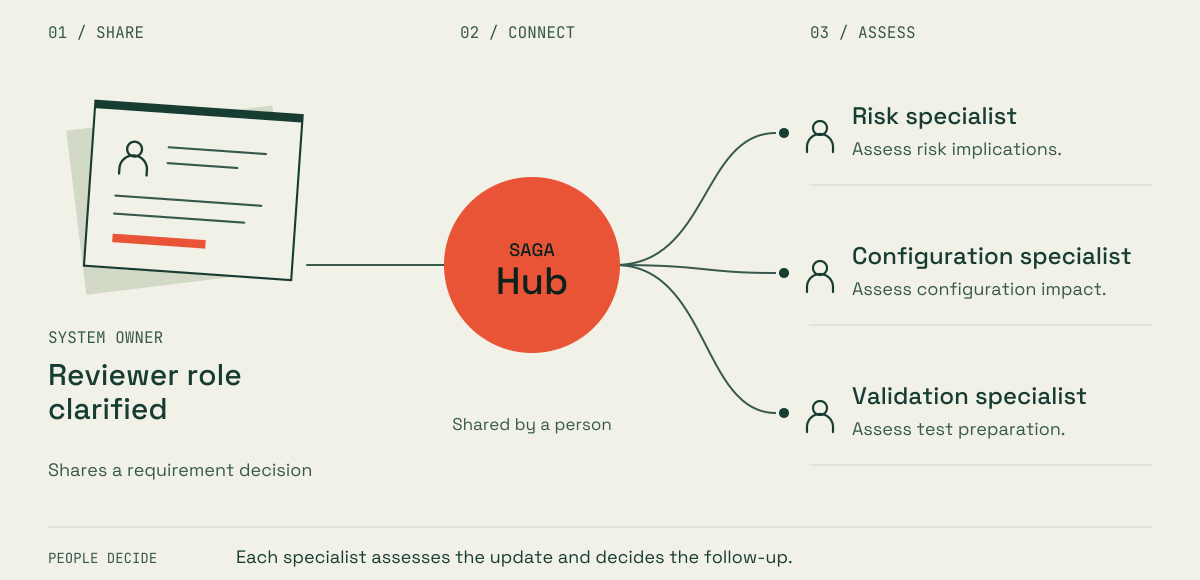
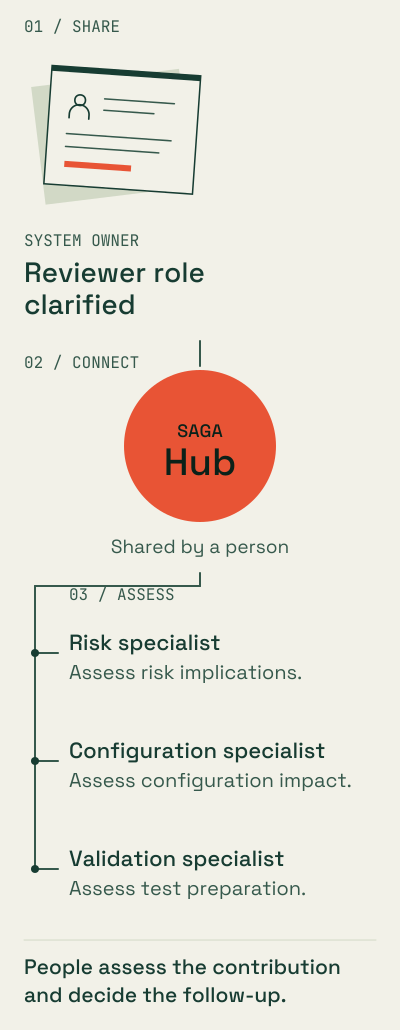
A clarified requirement can raise different questions for the people working on risk, configuration, and testing. SAGA Hub carries published decisions, findings, and handovers between project participants. Recipients can work with their agents to examine what an update means in their own project context.
In the illustrative document-review example, the system owner might clarify which users can hold the Reviewer role. That decision can be shared through Hub for the risk, configuration, and validation specialists to assess. Each considers whether their work needs to change and decides how to follow up.
We agree Hub's inclusion and scope for your setup. Your team directs the follow-up; formal approvals remain in your controlled systems.
06
Your team owns the validation conclusion.
SAGA helps prepare the deliverables. Your specialists verify the professional content, perform the required activities, and evaluate the evidence. Formal approval, signatures, and controlled records remain in your organization’s systems and procedures.
SAGA does not sign or write to your DMS or QMS. AI assistance does not establish that your system is validated.
LET’S TALK
Bring one CSV task to the conversation.
Tell us which system you are working on, which deliverable you need, and how your team reviews it. We can discuss where SAGA fits and what the supported workflow would need to cover.